

Beyond the Whales: Baja Gray Whale Watching Tours, Desert Wilderness, and the Sea of Cortez
A naturalist’s guide to choosing a Baja gray whale watching tour. From close encounters with gray whales to boojum forests and the Sea of Cortez, here’s why a multi-day trip can be about much more than whale watching.
Imagine floating in a small boat on a quiet Baja California lagoon.
A gray whale surfaces nearby. Then another.
Suddenly, a mother whale and her calf change direction and begin swimming toward your boat.
They approach voluntarily.
The calf surfaces beside you, close enough that you can look directly into its eye.
For seasoned wildlife travelers, few experiences compare with this.
Now imagine that this encounter is only one part of a six-day journey through some of North America’s most extraordinary protected wilderness.
One day, you’re watching gray whales and their newborn calves in a UNESCO World Heritage sanctuary.
Another, you’re crossing a vast desert filled with towering, otherworldly plants.
And later, you’re exploring the turquoise water of the Sea of Cortez: watching dolphins, landing on remote islands, perhaps snorkeling with sea lions.
That is the difference between taking a whale-watching trip and experiencing the remarkable natural diversity of Baja California.

In brief
- Baja’s three main gray whale breeding areas are Scammon’s Lagoon (Laguna Ojo de Liebre), San Ignacio Lagoon, and Magdalena Bay. The season runs from mid-December to mid-April.
- On Mexico’s February 9, 2026 census, Scammon’s Lagoon held 523 gray whales, including 107 mothers with calves. San Ignacio held 59, including 6 mothers with calves.
- Most multi-day Baja gray whale watching tours focus on one lagoon, either from a shoreside camp or aboard a ship. A few also take in the Valle de los Cirios desert and the Sea of Cortez.
- The real choice is depth versus breadth: more days at one lagoon, or whales plus Baja’s other diverse ecosystems.
Scammon’s Lagoon: One of the World’s Great Gray Whale Nurseries
Every winter, eastern North Pacific gray whales swim roughly 10,000 kilometers (about 6,000 miles) from Arctic feeding grounds to the warm, sheltered lagoons of Baja California. They come to mate, give birth, and nurse their calves.
Two of their most important destinations are Laguna Ojo de Liebre, better known as Scammon’s Lagoon, and Laguna San Ignacio. Together they form the Whale Sanctuary of El Vizcaíno, a UNESCO World Heritage Site since 1993. Both are famous for an extraordinary phenomenon: whales that choose to approach small boats.
San Ignacio has long drawn international attention for its “friendly whales.” But those encounters aren’t exclusive to San Ignacio. Mothers and calves in Scammon’s Lagoon are curious, too.
Scammon’s has another advantage: sheer numbers. Mexico’s National Commission of Natural Protected Areas (CONANP) counts the whales throughout the season. Its fourth census of 2026, conducted on February 9, recorded:
- 523 gray whales in Scammon’s Lagoon, including 107 mothers with calves
- 59 gray whales in San Ignacio Lagoon, including 6 mothers with calves
That’s roughly nine times as many whales in Scammon’s on the same day. More whales don’t guarantee a closer encounter. But they do mean more animals, more behavior to watch, and more chances that a curious one will come over to say hello.
Why One Boat Trip Isn’t Enough
There’s something deeply satisfying about returning to a whale nursery over several days.
On your first outing, you might watch whales breaching or traveling through the lagoon. On another, you may find mothers guiding young calves through the shallows. And perhaps, when conditions are right, a curious whale chooses to linger beside your boat.
Whales are wild animals. No responsible operator can promise how they’ll behave, and Scammon’s afternoon winds can cancel a single scheduled trip. That’s precisely why multiple outings matter: they give you different behaviors, different light, and room to work around the weather.
The goal isn’t to check gray whales off a wildlife list. It’s to spend enough time with them to appreciate their lives.
El Vizcaíno: The Bigger Conservation Story
The whale lagoons are part of a much larger story. El Vizcaíno Biosphere Reserve covers more than 2.5 million hectares (about 6.2 million acres) of desert, mountains, coastal wetlands, and sea in central Baja. It is one of Mexico’s largest protected areas, home to salt marshes, dunes, mangroves, migratory birds, sea turtles, and the endangered peninsular pronghorn.
Protecting these lagoons played a major role in the gray whale’s recovery from commercial whaling, which nearly emptied them after Captain Charles Scammon found his way in during 1857.
That recovery isn’t something to take for granted. CONANP counted only 69 calves in the two lagoons during the 2024–2025 season, far below the historical average, and scientists are watching the population closely. Whale watching here follows Mexico’s official standard, NOM-131-SEMARNAT-2010, which limits boat numbers, speed, and approach. Viewing is restricted to designated zones and run by authorized local operators, and calving areas stay off-limits.
A great whale encounter should always happen on the animal’s terms.
Valle de los Cirios: Baja’s Otherworldly Desert
One of the most overlooked parts of a Baja wildlife trip is the journey across the peninsula itself.
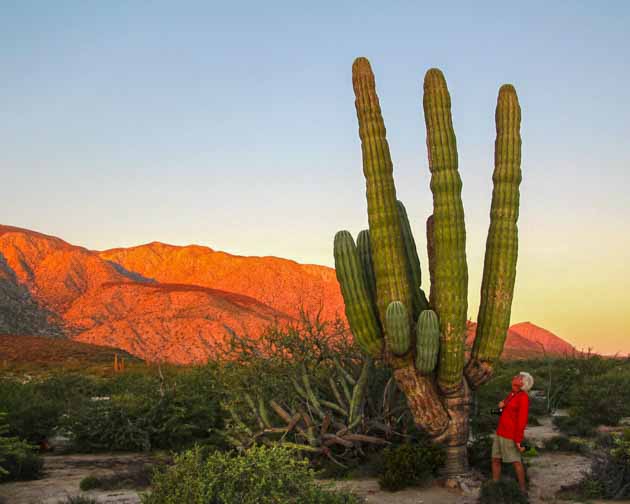
Far from empty, Baja’s desert is an extraordinary ecosystem. The Valle de los Cirios Flora and Fauna Protection Area spans about 2.5 million hectares north of Guerrero Negro. It’s named for the cirio, or boojum tree: a tall, tapering plant that can look like a giant candle, a crooked sculpture, or something Dr. Seuss imagined. Boojums grow almost nowhere else on Earth.
They share the landscape with giant cardón cacti (the tallest cactus species in the world), elephant trees, and a remarkable range of endemic plants, along with desert bighorn sheep, reptiles, and birds. This isn’t the manicured desert of a resort. It’s vast and rugged, with mountains stretching to the horizon.

For natural history lovers, the desert is every bit as fascinating as the sea. Exploring it with a naturalist turns the drive between coasts into one of the trip’s revelations, because you watch Baja transform from Pacific lagoon to cactus forest to the Gulf of California.
The Sea of Cortez: A Second World of Wildlife
On the peninsula’s eastern shore, a completely different world waits. The Sea of Cortez, also called the Gulf of California, is among the most biologically rich seas on the planet. Its islands and protected areas form a second UNESCO World Heritage Site, inscribed in 2005.
Jacques Cousteau called it “the aquarium of the world.” In 1940, John Steinbeck and marine biologist Ed Ricketts spent weeks cataloging its tide pools, an expedition later published as The Log from the Sea of Cortez. Its waters hold dolphins, California sea lions, fin whales and other whale species, seabirds, and hundreds of species of fish.
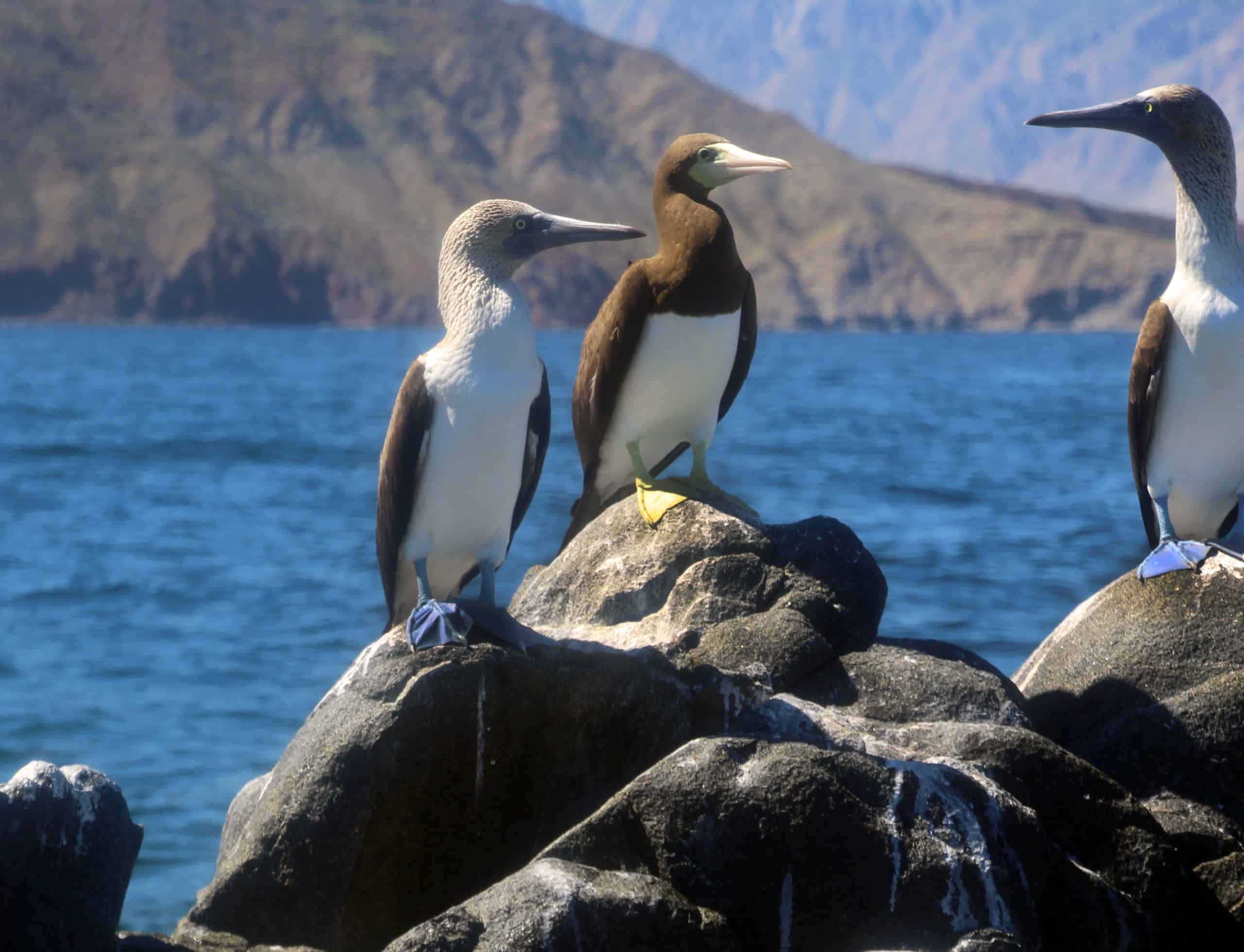
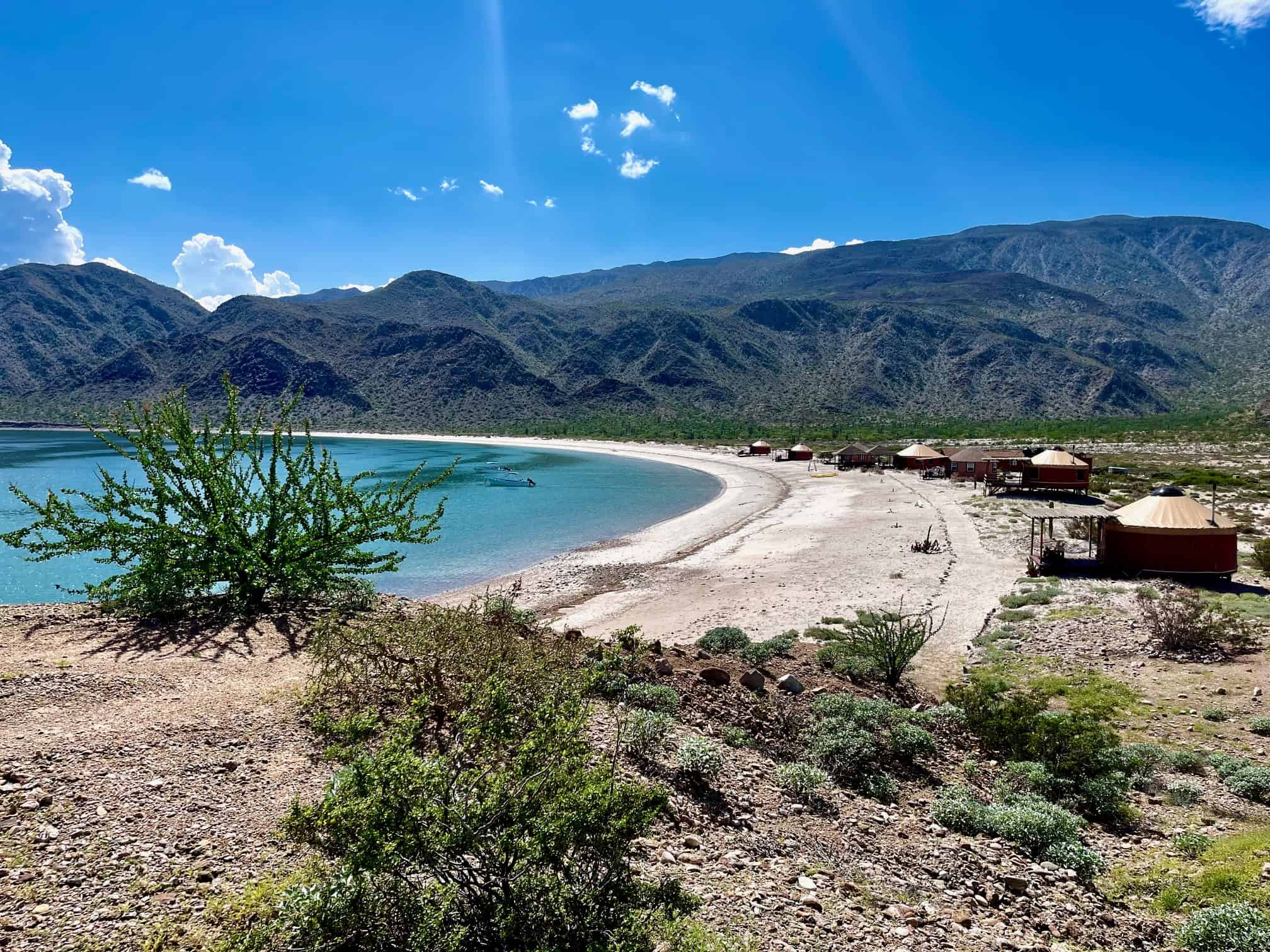
Depending on the season and conditions, days here might mean snorkeling at a nearby sea lion colony, searching for dolphins and fin whales, landing on islands thick with seabirds, or paddling a kayak along desert cliffs. At a wilderness lodge, free time can be just as rich: a stand-up paddleboard at sunrise, a windsurfing session when the afternoon breeze fills in, or a snorkel straight off the beach. At night, far from any town, the stars come down to the waterline.
Two coasts, two UNESCO World Heritage Sites, and one of the world’s strangest deserts in between.
Baja Gray Whale Watching Tours Compared: 7 Multi-Day Operators
Seven respected operators run multi-day Baja gray whale watching tours, and each is built for a different kind of traveler. The best choice depends on one question: do you want as much time as possible with gray whales at a single lagoon, or whales as the centerpiece of a broader Baja nature journey?
Baja Spirit Ecolodges & Tours: whales, desert, and the Sea of Cortez
Baja Spirit’s six-day Best of Baja trip from San Diego includes four gray whale outings in Scammon’s Lagoon, then crosses the Valle de los Cirios desert to Bahía de los Ángeles.
From there, a panga carries guests 14 miles along the coast and past bird-filled islands to Las Animas Wilderness Ecolodge, a private 185-acre property with no road access that can be reached only by boat and surrounded by pure wilderness. No other buildings or lights as far as you can see. Over three nights there, guests join four or more guided nature expeditions on the Sea of Cortez: snorkeling with sea lions, searching for dolphins and fin whales, and visiting seabird islands. Between outings, the lodge’s kayaks, stand-up paddleboards, windsurfing rigs, and snorkel gear are yours to use as much as you like at no extra charge, and desert trails lead into the hills behind the beach.
The trip is all-inclusive. Guests stay in a B&B with private rooms and bathrooms in Guerrero Negro near the lagoon, then in deluxe beachside yurt suites at Las Animas (more on lodging below). Travel from San Diego is in a guided luxury 15-passenger van, and groups are capped at 10. See the full Best of Baja whale tour itinerary. Guests have seen friendly whale behavior on every Baja Spirit outing in Scammon’s Lagoon.
The difference: It’s the only trip here that combines a Pacific whale nursery, a protected desert, and four or more Sea of Cortez expeditions from a boat-in wilderness lodge. You trade some extra lagoon time for far more Baja wildlife and landscape variety.
Baja Jones Adventure Travel: a shoreside camp on Scammon’s Lagoon
Five- and six-day trips go to a private camp of insulated, wood-sided cabins on the edge of Scammon’s Lagoon, inside the Vizcaíno Biosphere Reserve. The camp holds up to 24 guests. Guests travel from San Diego by ground or small plane and go out twice a day on roughly 90-minute panga trips. Evenings include talks by Keith Jones.
The difference: The whole trip stays at one lagoon, with more whale outings than any cross-peninsula trip. It’s a strong choice for dedicated whale watchers and photographers. It doesn’t include a desert crossing or time on the Sea of Cortez.
Baja Ecotours: Campo Cortez Ecolodge, San Ignacio Lagoon
This family-run lodge has solar-powered beachside cabins with real beds and USB charging on San Ignacio Lagoon. Trips run five to eight days, typically with two whale outings a day. Some packages add the Sea of Cortez town of Loreto, and many use charter flights from San Diego.
The difference: San Ignacio is smaller and quieter, and it’s famous for friendly whales. It also holds far fewer whales than Scammon’s. The Sea of Cortez portion is a town stay, not a wilderness lodge.
Baja Discovery: tent camp on San Ignacio Lagoon
Five-day trips fly guests by private charter from San Diego to a low-impact, safari-style tent camp on a bluff above San Ignacio Lagoon. Activities include whale watching, birding, mangrove kayaking, and walks in the desert and tide pools.
The difference: It’s a classic lagoon-camp experience in safari tents, reached by plane, centered on San Ignacio.
Natural Habitat Adventures: Kuyimá Whale Camp, San Ignacio Lagoon
Natural Habitat partners with Kuyimá, a long-running camp on San Ignacio Lagoon with beachfront cabanas, private bathrooms, and bucket showers. The camp is being refurbished for the 2027 season.
The difference: It offers the polish of a large international tour company at a single-lagoon camp.
Baja Expeditions: glamping camp, San Ignacio Lagoon
This long-established Baja operator runs an upgraded camp of 12 heated glamping tents and 2 family tents at San Ignacio Lagoon. Each tent has a private ensuite bathroom with a hot shower, and the camp has power around the clock. Guests fly in from Cabo San Lucas.
The difference: It’s the most hotel-like tent camp on the lagoons. It’s reached from Cabo San Lucas rather than San Diego.
Lindblad Expeditions–National Geographic: Magdalena Bay by ship
Five-night voyages aboard the roughly 62-guest National Geographic Sea Bird focus on the gray whales of Magdalena Bay in Baja California Sur.
The difference: You sleep in a ship’s cabin and watch whales in Magdalena Bay, a long open bay rather than one of the UNESCO-protected nursery lagoons. You travel with a larger group and don’t stay at a lodge on land.
Side-by-side comparison
| Operator | Whale location | Lodging | Group size | Getting there | Desert + Sea of Cortez |
|---|---|---|---|---|---|
| Baja Spirit | Scammon’s Lagoon | B&B + deluxe beachside yurt suites (boat-in only) | 10 guests max | Guided luxury 15-passenger van | Yes: desert tour crossing + 4 or more Sea of Cortez expeditions |
| Baja Jones | Scammon’s Lagoon | Insulated wood cabins | Up to 12 per trip; camp holds 24 | Ground or small plane | No |
| Baja Ecotours | San Ignacio Lagoon | Ecolodge cabins | Up to 26 | Charter flight or ground | Some trips add Loreto |
| Baja Discovery | San Ignacio Lagoon | Safari tent camp | Up to 28 | Charter flight | No |
| Natural Habitat (Kuyimá) | San Ignacio Lagoon | Beach cabanas | 10-cabana camp | Check operator | No |
| Baja Expeditions | San Ignacio Lagoon | Heated glamping tents, ensuite | 14-tent camp | Flies from Cabo San Lucas | No |
| Lindblad–Nat Geo | Magdalena Bay | Ship cabin | ~62 guests | Fly to Baja Sur | No |
Lodging compared: tent camps, cabins, ship cabins, and yurt suites
For many travelers, where they sleep matters as much as where they watch whales. Baja’s multi-day options fall into four styles, and each trades closeness to the whales against comfort in a different way.
| Lodging style | Who offers it | What to expect | Best for |
|---|---|---|---|
| Safari and glamping tents | Baja Discovery; Baja Expeditions | Canvas tents on the lagoon shore. Baja Discovery runs a low-impact safari-style camp. Baja Expeditions’ tents are heated, with real beds and private ensuite baths with hot showers. | Falling asleep to whales breathing in the dark |
| Lagoon cabins | Baja Jones; Baja Ecotours; Kuyimá (Natural Habitat) | Solid-walled cabins with real beds. At Baja Jones, private baths are a limited upgrade. Kuyimá’s cabanas have private baths with flush toilets and bucket showers. Baja Ecotours’ cabins have charging stations; ask about bathrooms. | Staying right on the water with walls and a real bed |
| Ship cabins | Lindblad–National Geographic | Private cabins aboard a roughly 62-guest expedition ship, with meals and lectures on board. | Travelers who prefer cruising to camps |
| B&B + deluxe beachside yurt suites | Baja Spirit | A B&B with private rooms and bathrooms in Guerrero Negro, near Scammon’s Lagoon. Then a boat-in wilderness lodge on the Sea of Cortez: eight beachside yurt suites, each with a California King plus a twin bed, a private ensuite bathroom with a hot-water shower, and skylights. Solar power with 120V outlets and Starlink internet. | Beachside hotel-level comfort in a remote wilderness setting. Sleep to the sound of gentle surf. |
The honest trade-off: a lagoon camp puts you closest to the whales, sometimes close enough to hear them at night. Baja Spirit’s guests sleep in town near Scammon’s Lagoon rather than on its shore. In return, they get a private bathroom every night and finish the trip in a spacious beachside suite on a wild stretch of the Sea of Cortez that no road reaches.

Which one fits you?
| What matters most to you | Good fit |
|---|---|
| The largest gray whale concentrations | Scammon’s Lagoon trips: Baja Spirit, Baja Jones |
| The most whale outings per day | Baja Jones, Baja Ecotours (two outings a day) |
| Sleeping on the lagoon shore | Baja Jones, Baja Discovery, Kuyimá, Baja Expeditions, Baja Ecotours |
| Maximum time at one lagoon, camp-style | Baja Jones, Baja Discovery, Kuyimá, Baja Expeditions |
| San Ignacio’s quieter, remote lagoon | Baja Ecotours, Baja Discovery, Natural Habitat, Baja Expeditions |
| A small-ship cruise | Lindblad–National Geographic |
| Whales plus the Valle de los Cirios desert and Sea of Cortez wildlife | Baja Spirit |
| A private boat-in ecolodge on the Sea of Cortez, with 4 or more nature expeditions | Baja Spirit |
| Deluxe private beachside suites with ensuite baths, hot-water showers, Starlink, and 120V power | Baja Spirit |
| All-inclusive, with unlimited kayaks, paddleboards, windsurfing, snorkeling, and hiking at no extra charge | Baja Spirit |
| No flights: guided ground tour from San Diego | Baja Spirit |
| Groups of 10 or fewer | Baja Spirit |
For travelers who have already been to the Galápagos, Africa, or Antarctica, the decision usually comes down to depth versus breadth. A lagoon camp or a ship offers deep immersion in one extraordinary habitat. A cross-peninsula trip offers substantial whale time plus a unique pristine desert and marine ecosystems that make Baja unlike anywhere else.
Neither is inherently better. But if you love natural history, wildlife variety, and a comfortable bed at the end of a wild day, the broader journey has real appeal.
What Does a Multi-Day Baja Gray Whale Watching Tour Cost?
Prices vary widely by style, and headline numbers aren’t always comparable. When you compare trips, check four things:
- Flights: Is the charter or domestic flight included, or extra?
- Taxes and park fees: Mexican IVA (16%) and marine park fees are often listed separately.
- Drinks and gratuities: Are alcoholic drinks included? How are tips handled?
- Nights versus whale days: How many full days are actually spent on the water?
For reference, Baja Spirit’s six-day trip starts at $4,495 per person for the 2027 season, plus 16% taxes and fees. The trip is all-inclusive: free hotel pickup, a new luxury van transportation from San Diego starting 2027, lodging, meals, drinks, guided outings, and unlimited use of the lodge’s sports equipment. See Best of Baja dates and pricing. It’s a substantial investment. But experienced travelers know the value of a remote wildlife trip isn’t measured by the nightly rate. It’s measured by the quality of the encounters, the depth of the guiding, and the places you couldn’t reach on your own.
When Is the Best Time for a Baja Gray Whale Watching Tour?
The official viewing season in El Vizcaíno runs from December 15 to April 15. Mid-February through March is the sweet spot for a multi-day trip. In 2026, counts in Scammon’s Lagoon peaked in early to mid-February. By late February and March, calves are older, livelier, and often more curious about boats. Numbers and behavior change every year, so neither sightings nor close encounters can be guaranteed.
A Wildlife Experience That Goes Beyond the Whales
Perhaps Baja’s greatest gift is its contrasts.
Where else can you start a morning beside a mother gray whale and her calf, cross a desert of bizarre and beautiful plants, and end the journey on a remote island-studded sea on the far side of the peninsula without another human being in sight?
Baja remains a place where enormous stretches of land and sea keep their wild character. Its protected areas remind us that conservation isn’t only about saving individual species. It’s about protecting whole ecosystems, and the extraordinary relationships between them.
The whales may be what first draw you to Baja.
But the deserts, the islands, the wildlife, the Sea of Cortez and the sheer beauty of this peninsula may be what make the journey unforgettable.
Curious about the trip Kevin leads? See the Best of Baja gray whale watching tour itinerary and 2027 dates. For a deeper look at the lagoons themselves, read our guide to Scammon’s Lagoon vs. San Ignacio vs. Magdalena Bay.
Frequently Asked Questions
What are the best places in Baja to see gray whales?
The three main gray whale breeding areas are Scammon’s Lagoon (Laguna Ojo de Liebre), San Ignacio Lagoon, and Magdalena Bay. Scammon’s Lagoon recorded the highest count in 2026, with 523 whales on February 9.
Is Scammon’s Lagoon better than San Ignacio for gray whale watching?
Scammon’s Lagoon has far more whales: Mexico’s February 9, 2026 census counted 523 gray whales there, including 107 mother-calf pairs, versus 59 whales at San Ignacio. Both lagoons have whales that approach boats voluntarily; San Ignacio is smaller and more remote.
Can you get close to gray whales in Scammon’s Lagoon?
Yes. Gray whales, including mothers and calves, often approach small boats on their own. Encounters follow Mexico’s NOM-131-SEMARNAT-2010 whale-watching rules and can never be guaranteed.
Which companies offer multi-day Baja gray whale watching tours?
Multi-day operators include Baja Spirit and Baja Jones at Scammon’s Lagoon; Baja Ecotours, Baja Discovery, Natural Habitat Adventures (Kuyimá camp), and Baja Expeditions at San Ignacio Lagoon; and Lindblad Expeditions–National Geographic, which visits Magdalena Bay by ship.
Is there a Baja whale tour that also includes the desert and the Sea of Cortez?
Yes. Baja Spirit’s six-day trip from San Diego combines four Scammon’s Lagoon whale outings with a Valle de los Cirios desert crossing. It then spends three nights at Las Animas Wilderness Ecolodge, which is reachable only by boat, with four or more guided Sea of Cortez nature expeditions, plus unlimited use of kayaks, paddleboards, windsurfing, and snorkel gear at no extra charge. Most other multi-day tours stay at one lagoon or travel by ship.
What kind of lodging do multi-day Baja whale tours use?
Options include safari or glamping tents on the lagoon shore (Baja Discovery, Baja Expeditions), lagoon tent cabins (Baja Jones, Baja Ecotours, Kuyimá), ship cabins (Lindblad–National Geographic), and a B&B plus deluxe beachside yurt suites with private ensuite baths and hot-water showers at a boat-in Sea of Cortez ecolodge (Baja Spirit).
How do you get to Scammon’s Lagoon from San Diego?
Scammon’s Lagoon is next to the town of Guerrero Negro, roughly halfway down the Baja peninsula. Tour operators reach it from San Diego by guided ground transportation or small plane; Baja Spirit uses a guided luxury 15-passenger van, so no flights are needed.
What is Valle de los Cirios?
Valle de los Cirios is a protected desert of about 2.5 million hectares in Baja California, famous for boojum trees, giant cardón cacti, and endemic plants. It lies between Scammon’s Lagoon and the Sea of Cortez coast at Bahía de los Ángeles.
When is the best time for a Baja gray whale watching tour?
Mid-February through March is ideal. The official season runs December 15 to April 15, and whale numbers in the lagoons usually peak in mid-February.
Is a Baja gray whale watching tour suitable for travelers over 50?
Yes. Many multi-day whale travelers are over 50. The main requirement is being comfortable stepping in and out of small boats; ask each operator about lodging access and any optional activities.
How big are groups on multi-day Baja whale tours?
It varies by operator, from small camp groups to ships carrying around 60 guests. Baja Spirit limits its gray whale trip to 10 guests.

About the author
Kevin Warren is a naturalist, commercial pilot, and Wilderness First Responder who has explored Baja’s lagoons, deserts, and islands since founding Baja Spirit Ecolodges & Tours in 1989. Read Kevin’s full bio.
Sources
- Excélsior: CONANP fourth gray whale census, February 2026
- Milenio: CONANP 2025–2026 season and 2024–2025 calf counts
- UNESCO: Whale Sanctuary of El Vizcaíno
- UNESCO: Islands and Protected Areas of the Gulf of California
- CONANP: Valle de los Cirios
- Baja Jones Adventure Travel: 6-day whale watching
- Baja Ecotours: 5-day air trip to San Ignacio Lagoon
- Natural Habitat Adventures: Kuyimá Whale Camp
- Baja Expeditions: San Ignacio Glamping Camp
- Baja Ecotours: Campo Cortez accommodations
Travel planning note: This guide reflects published 2027 itineraries and conservation data available in October 2026. Whale behavior, tour schedules, activities, and prices are subject to change.